


Ascending stairs, walking the dog, and getting up from a favorite chair are simple daily activities that, for patients with knee osteoarthritis, can become daily reminders of pain and declining mobility.
Medical professionals have a range of options to help, but persistent symptoms often call for a broader approach to improving comfort, preserving function, and keeping patients active.
Shockwave can expand the options available within that treatment plan. Radial Pressure Wave (Extracorporeal Pulse Activation Technology, EPAT®) and Focused Shockwave (Extracorporeal Shockwave Therapy, ESWT) deliver acoustic energy that can play a key role in reducing knee osteoarthritis pain and improving function. A related electromagnetic technology, EMTT® (Extracorporeal Magnetotransduction Therapy), offers another option within multimodal care.
In this article, we’ll explore Shockwave as a treatment for knee osteoarthritis, highlight relevant research, and examine how thoughtful integration can support patient outcomes and expand your practice’s capabilities.
Evidence-Based Treatment for Knee Osteoarthritis
Knee osteoarthritis involves the breakdown of joint cartilage and changes in surrounding tissues, including bone and the joint lining. Pain, stiffness, and swelling can progressively interfere with mobility and everyday function.
Treatment typically combines several approaches based on symptom severity and patient needs:
- Exercise and physical rehabilitation to strengthen supporting muscles and maintain mobility.
- Weight management, where appropriate, to reduce stress on the knee.
- Medications to help manage pain and inflammation.
- Bracing, activity modification, and patient education to support everyday movement.
- Joint replacement surgery when symptoms remain severe despite nonsurgical care.
A multimodal plan allows medical professionals to address pain, strength, and functional limitations together, and Shockwave can be a valuable addition.
Shockwave for Knee Osteoarthritis
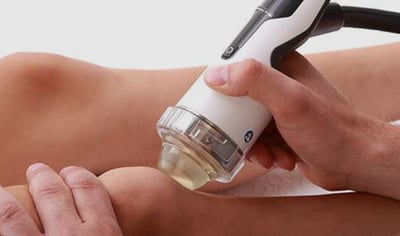
 Shockwave is an evidence-based treatment that delivers acoustic energy to targeted tissues in and around the knee, with the goal of reducing pain and improving function. Medical professionals can use Radial Pressure Wave to address broader, superficial treatment areas or Focused Shockwave to reach more precisely defined targets at depth.
EMTT can complement Shockwave by delivering electromagnetic energy across a broader treatment area. Together, these technologies offer non-invasive options that can be incorporated alongside strengthening, mobility exercises, and other appropriate care. Helping patients move more comfortably may also support their participation in the rehabilitation needed to maintain strength and everyday function.
For a broader look at treating conditions outside of the knee, explore our blog on Shockwave and EMTT for Osteoarthritis.
Research Highlights: Shockwave and Knee Osteoarthritis
30+ years of Shockwave research have built an immense body of evidence on its positive impact on a wide variety of musculoskeletal conditions, including knee osteoarthritis:
- Nearly 50% reduction in pain at 12 weeks: In a randomized study of 70 patients with knee osteoarthritis, four weekly Shockwave sessions produced greater pain relief and functional improvement than placebo treatment. Average pain scores in the Shockwave group fell from 7.56 to 3.83 at 12 weeks, a reduction of approximately 49%. Improvements in disability scores accompanied that relief, offering encouraging results for patients whose knee symptoms limit everyday movement.
Study: Efficacy of extracorporeal shockwave therapy for knee osteoarthritis: a randomized controlled trial. Journal of Surgical Research, 2013.
- Stronger rehabilitation outcomes maintained at six months: A study of 120 patients with knee osteoarthritis and popliteal cyamella (a sesamoid bone behind the knee) found that adding Shockwave to strengthening exercises produced greater improvements in muscle strength and disability than exercise alone or exercise combined with ultrasound.
Study: The efficacy of shock wave therapy in patients with knee osteoarthritis and popliteal cyamella. The Kaohsiung Journal of Medical Sciences, 2014. - Treatment settings influenced pain relief and functional recovery: A randomized study of 60 patients compared two Shockwave energy levels delivered over three weekly sessions. Both groups experienced improvements in pain and function, but the medium-energy group achieved greater improvements at one, four, and 12 weeks after treatment.
Study: The Dose-Related Effects of Extracorporeal Shock Wave Therapy for Knee Osteoarthritis. Annals of Rehabilitation Medicine, 2015. - Reduced pain and better function across 14 clinical trials: A systematic review and meta-analysis involving 782 participants found that Shockwave improved short-term pain and function in patients with knee osteoarthritis. Pooled results showed an average pain-score advantage of approximately 1.7 points on a 10-point scale compared with control treatments.
Study: Extracorporeal shockwave therapy improves pain and function in subjects with knee osteoarthritis: A systematic review and meta-analysis of randomized clinical trials. International Journal of Surgery, 2020.
- Evidence supporting Shockwave alongside strengthening exercises: A 2024 systematic review found that Shockwave improved knee osteoarthritis outcomes compared with sham treatment and that combining Shockwave with strengthening exercises was more effective than exercise alone.
Study: A systematic review of the use of shockwave therapy for knee osteoarthritis. Journal of Orthopaedics, 2024.
Shockwave and EMTT in Multimodal Knee Osteoarthritis Treatment
 Knee osteoarthritis care often centers on helping patients stay active while addressing the pain that makes movement difficult. A patient may understand the value of strengthening exercises yet struggle to complete them comfortably. Incorporating Shockwave into the continuum of care gives providers another way to address symptoms while rehabilitation builds strength and supports mobility.
EMTT offers another noninvasive option, using electromagnetic fields rather than the acoustic energy delivered by Shockwave. In a randomized, placebo-controlled trial involving 126 patients, including 31 with knee osteoarthritis, eight weekly EMTT sessions improved pain and physical health scores across the overall study population, with benefits persisting 12 weeks after treatment.
Shockwave and EMTT can broaden the practice’s continuum of care across a range of MSK conditions while supporting sustainable practice growth. For the practice, developing expertise in Shockwave and EMTT creates opportunities to:
- Connect with patients seeking additional nonsurgical options. Patients whose knee pain continues to interfere with walking, exercise, or work may be looking for another approach. Explaining how these technologies fit alongside rehabilitation helps them understand both the available options and the purpose of a multimodal plan.
- Keep patients engaged in their care. Clear expectations and regular assessments help patients recognize progress beyond a pain score. Walking farther, managing stairs more comfortably, or returning to a favorite activity gives treatment a practical focus and helps providers adjust the plan as needs change.
- Strengthen patient relationships and referrals. Knee osteoarthritis often requires ongoing management. Helping patients navigate that process with consistent guidance and attention to their goals can build lasting trust and give satisfied patients a meaningful experience to share with friends and family.
Sourcing the Right Shockwave Technology for Your Practice
Bring additional nonsurgical treatment options to your patients with technology and guidance from CuraMedix. As a distributor of STORZ Medical Shockwave and EMTT devices, CuraMedix helps medical professionals move from evaluating equipment to confidently incorporating it into clinical care. Practical training, continued learning opportunities, and dedicated support help your team develop the skills to put these technologies to work.
Contact CuraMedix to discuss Shockwave and EMTT for your practice’s knee osteoarthritis and broader musculoskeletal care offerings.
Frequently Asked Questions
What treatment options are available for knee osteoarthritis?
Treatment for knee osteoarthritis can include exercise, physical therapy, weight management, medications, injections, and surgery when appropriate. Shockwave gives medical professionals an additional nonsurgical option to consider for patients whose pain continues to interfere with daily life.
What are the goals of knee osteoarthritis treatment?
Treatment aims to reduce pain, maintain mobility, and help patients continue the activities they value. Whether the priority is walking the dog, managing stairs, or returning to golf, those goals give providers and patients a practical way to assess progress.
Why is multimodal care important for knee osteoarthritis?
Knee osteoarthritis can affect strength, movement, and everyday activity as well as comfort. Combining treatments allows providers to address these connected needs. Pain management, strengthening exercises, and activity adjustments can each contribute to helping patients stay active.
How does Shockwave fit into knee osteoarthritis treatment?
Shockwave can complement a broader plan that addresses pain, strength, and mobility. For patients, the goals are practical: walking comfortably, managing stairs, staying active, and participating more fully in rehabilitation.
What is the best multimodal treatment plan for knee osteoarthritis?
An effective plan connects treatment to the individual patient’s needs and priorities. Providers consider what the patient has already tried, what continues to limit activity, and how treatments can work together. Shockwave and EMTT may broaden those options, while regular reassessment keeps care focused on meaningful improvements.

