
Medical practices invest in Shockwave to expand options for patients with a non-invasive, evidence-based treatment option that supports tissue repair, recovery, and improved function across a range of musculoskeletal and soft tissue conditions.
When implemented well, that clinical value can also translate into meaningful business value. Radial Pressure Wave (Extracorporeal Pulse Activation Technology, EPAT®) and Focused Shockwave (Extracorporeal Shockwave Therapy, ESWT) can help practices differentiate their services, support patient retention and referrals, create new cash-pay opportunities, and make better use of existing clinical workflows. Practices may also combine Shockwave with related energy-based technologies such as EMTT® (Extracorporeal Magnetotransduction Therapy) as part of a broader multimodal treatment strategy.
In this article, we’ll look at proven ways Shockwave can support medical practice revenue while keeping patient care at the center of the decision. We’ll also explore why long-term success depends not just on buying the right technology, but on integrating it strategically into your treatment model.
1: Shockwave Creates A Beneficial Cycle of Patient Experiences
The most sustainable path to practice growth starts with patient outcomes, and over 80% of patients are satisfied with their Shockwave treatments. John Knab, MD of The Center for Pain Management, reports that “The integration of Shockwave into all of my non-surgical spinal and orthopedic treatments has enhanced my outcomes significantly over the past 8 years.”
When patients experience meaningful improvement, they are more likely to:
- Complete their treatment plan
- Return when new issues arise
- Refer friends, family members, or teammates who may be struggling with similar conditions.
 That dynamic is especially important for treatments like Shockwave, where patient education and expectations play a major role in adoption. Over time, understanding creates a beneficial cycle: better patient experiences support stronger trust, stronger trust supports treatment follow-through, and successful outcomes can lead to more referrals and long-term patient retention. For the practice, revenue growth follows from doing what already matters most: helping patients get better.
You can learn more about how to improve patient care with Shockwave therapy in our whitepaper on the Art of Shockwave.
2: Time-Efficient Treatments Promote Patient Volume
Shockwave can support medical practice revenue by giving providers a treatment option that is efficient to deliver within the flow of a busy clinic. Once the practice has established appropriate protocols, patient selection criteria, and staff training, treatments can often be incorporated into your continuum of care without requiring the same time commitment as more invasive procedures or highly complex interventions.
Shockwave and EMTT can be performed efficiently by a physician or another properly trained medical professional, which gives the practice more flexibility in how it schedules care, allocates provider time, and supports patients across an active treatment plan.
For the practice, that creates a proven path to revenue growth: more patients can receive an evidence-based, non-invasive treatment option, while the team builds a workflow that supports consistency, patient access, and long-term utilization.
3: Shockwave Offers an Attractive Entry Point for New Patients
Shockwave can help bring new patients into the practice by giving them a clear reason to schedule a consultation. Many patients with persistent musculoskeletal pain have already tried rest, medication, injections, physical therapy, or other conservative approaches without getting the improvement they want. An evidence-based, non-invasive option like Shockwave can give those patients a more compelling next step.
 Patients are often searching for a specific solution to a specific problem: chronic heel pain, tendon pain, soft tissue injury, or a condition that keeps interfering with work, sport, or daily activity. Shockwave gives practices a way to speak directly to those concerns and position the clinic as a destination for advanced, non-invasive care.
Once a new patient enters the practice through Shockwave, the relationship does not have to begin and end with a single treatment series. The provider can evaluate the full clinical picture, educate the patient on appropriate options, and connect them with the broader care model when needed. In that sense, Shockwave can support revenue not only as a treatment offering, but as a patient acquisition pathway.
4: Shockwave Opens New Streams of Medical Practice Revenue
Shockwave can help practices build a revenue stream that is not entirely dependent on traditional payer reimbursement. Because many practices offer Shockwave as a self-pay treatment option, it can create a more direct connection between the clinical value of the treatment and the financial performance of the practice.
The key is to frame the treatment around patient education, not sales. Patients should understand:
- Why Shockwave is being recommended
- What condition it is intended to address
- How the treatment series works
- Where it fits relative to other available options
When that explanation is clear, patients are better equipped to evaluate the recommendation on its clinical merits rather than simply sorting choices into “covered” and “not covered.” Done well, the revenue opportunity follows from offering patients a non-invasive treatment option they understand, value, and are willing to pursue.
5: Shockwave Supports Efficient Implementation Inside the Practice
Shockwave provides a short runway to ROI because it can be integrated into the clinical workflow without the operational complexity of more invasive procedures. Practices do not necessarily need to create an entirely separate procedural infrastructure to begin offering Shockwave as part of patient care.
That creates practical economic advantages. A treatment option that fits into the existing rhythm of the clinic is easier to:
- Schedule flexibly
- Scale as patient demand grows
- Offer consistently across times and practice locations
This efficiency helps connect clinical access with revenue growth. More appropriate patients can be treated, provider time can be used more effectively, and the practice can add a non-invasive service line without introducing excessive friction into the day-to-day workflow.
6: Shockwave Offers Favorable Provider Ergonomics
Shockwave reduces the physical burden associated with certain hands-on treatment models. In many practices, provider capacity is limited not only by time, but by the amount of manual work a clinician can reasonably perform across a full day of patient care.
Because Shockwave is delivered through a device-based treatment process, it can create a more ergonomically sustainable way to address musculoskeletal and soft tissue conditions. The provider or trained medical professional still applies clinical judgment, selects appropriate treatment parameters, and guides the course of care, but the technology helps reduce reliance on physically demanding manual inputs alone.
That ergonomic advantage can have meaningful business implications. Less provider strain can support more consistent treatment delivery, preserve clinician energy across the schedule, and make the service line easier to sustain as patient demand grows. For practices where manual therapy, rehabilitation, or procedural workload already places pressure on provider capacity, Shockwave can offer a non-invasive treatment option that supports both patient care and long-term practice productivity.
7: Shockwave and EMTT Unlock a Multimodal Treatment Strategy
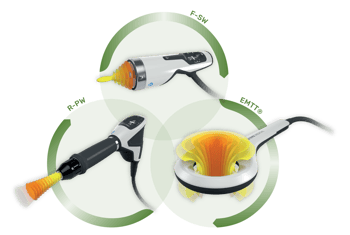 Shockwave can also boost medical practice revenue by becoming part of a broader multimodal treatment strategy. Rather than relying on a single technology for a narrow set of cases, practices can use complementary energy-based options to address more complex or chronic musculoskeletal and soft tissue conditions.
This is where the combination of Radial Pressure Wave, Focused Shockwave, and EMTT can become especially valuable. Each technology brings different clinical strengths, giving providers more flexibility in how they evaluate patient needs, sequence treatment, and build care plans around specific conditions or recovery goals.
From a revenue perspective, that broader treatment capability can expand the number of appropriate use cases inside the practice. It can also support higher-value care pathways for patients who may benefit from a combined approach, especially when a single intervention may not be enough to address the full clinical picture.
Learn More About Implementing Shockwave in Your Practice
Shockwave can be a powerful way to expand patient care while supporting sustainable practice growth, but the strongest results come from thoughtful implementation. Practices need the right technology, the right clinical strategy, and the right long-term support to turn Shockwave into a confident, consistently used part of their care model.
If you are interested in learning how real medical practices have integrated Shockwave and EMTT into everyday medical practice, our practice profiles are a great place to start.
CuraMedix supports medical professionals with the complete suite of STORZ Medical Radial Pressure Wave, Focused Shockwave, and EMTT devices, along with the education, training, service, and practical guidance needed to help practices integrate these technologies successfully.
If you are interested in bringing Shockwave or EMTT into your practice, connect with the CuraMedix team to discuss your goals, evaluate your options, and learn how a strategic implementation approach can support both patient outcomes and practice revenue.