


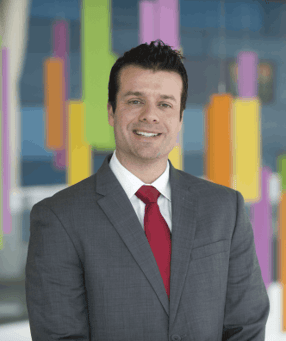
As the Division Director of Sports Medicine at Akron Children’s in Akron, Ohio, Dr. Derrick Eddy’s path to integrating Shockwave technology was paved by a career-long commitment to finding "new ways and new technologies to help people get better." After a pediatric residency at West Virginia University and a sports medicine fellowship in Akron, Dr. Eddy spent a decade in private practice before joining Akron Children’s. There, he would eventually become the Director of Sports Medicine, with a specialty in Shockwave technology for persistent pain, as well as sports medicine for kids, teens and adults.
The clinical tipping point occurred at the 2022 American Medical Society for Sports Medicine (AMSSM) conference during a talk by Dr. Adam Tenforde, MD on treating tendons with Shockwave. Intrigued, Dr. Eddy performed a deep dive into the existing literature surrounding Shockwave and quickly realized the immense effectiveness of the modality. Driven by the evidence, he sought out CuraMedix and attended their Institute for Tissue Regeneration & Repair (ITRR) conference in Boston to learn more about the science and research behind Shockwave, and gain the technical expertise necessary to launch a program at the hospital. From there, he incorporated both Focused Shockwave and Radial Pressure Wave into his continuum of care.
Clinical Outcomes: A Game-Changer for Pediatric Sports Medicine
In a hospital setting, introducing a new modality for children requires a rigorous focus on safety and evidence, with one of the biggest questions amongst hesitant providers being that of developing growth plates in pediatrics. Dr. Eddy addresses common concerns regarding growth plates by being transparent with families from the outset. It is important to note that many of the adolescents he treats are already skeletally mature, making growth plate considerations less relevant. Additionally, the International Society for Medical Shockwave Treatment (ISMST) no longer considers open growth plates a relative contraindication to shockwave therapy.
Emerging research also supports the use of shockwave therapy as a potential treatment option for certain apophyseal conditions. By adhering to established best practices and carefully avoiding treatment directly over the physis when there is any concern, Dr. Eddy has maintained a strong safety record while achieving an impressive 80% success rate across his patient population.
The clinical versatility of Shockwave has allowed Dr. Eddy to treat pathologies that were previously difficult to resolve. He frequently treats knees (patellar tendons), elbows, feet (Achilles and fascia), and myofascial pain syndromes. One standout pediatric case involved a cheerleader who had struggled for years with hamstring and posterior superior iliac spine (PSIS) pain. After 4-5 treatments, she was back to performing and executing routines for the first time in two years. He also successfully treated a pediatric patient with compartment syndrome whose symptoms persisted even after surgery, returning them to running after just 3 treatments.
The Business Case: ROI and Hospital Integration
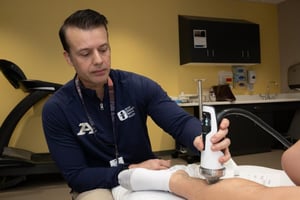 Integrating a cash-pay modality into a traditional hospital billing system can be a daunting administrative hurdle, but Dr. Eddy leveraged existing precedents to succeed. Because he was already performing PRP (a T-code), the speedbumps he encountered for Shockwave were minimal. He met with hospital administrators to assign a code for the service, making it a fairly smooth transition from a subjective idea to an operational reality.
The return on investment (ROI) has far exceeded both Dr. Eddy and the hospital’s expectations. While the team originally projected six patients per month, Dr. Eddy now sees that volume per clinic. “It’s exploded!” he reports. “I’ve been doing so much Shockwave that we have a waitlist.” This surge in utilization has even compelled him to work in the clinic on his “office-only” days to accommodate the demand.
The program’s success has fostered strong internal synergy between other departments in the hospital. While Dr. Eddy is currently the only one of eight sports medicine doctors utilizing Shockwave, many of his peers are now eager to adopt the technology after seeing the results. Furthermore, other departments like Orthopedics have become a major source of internal referrals, viewing Shockwave as a high-value tool that can be used "everywhere" in the body, all at once, unlike more localized treatments like PRP.
Advice for Hospital Providers
Dr. Eddy believes Shockwave therapy provides immense value to a hospital system by offering a non-invasive, cost-effective option for patients who have suffered for years. For peers struggling with hospital bureaucracy or seeking buy-in for "non-traditional" technology, his advice is simple: "Bring the data, show them the literature, and get to conferences like the Institute for Tissue Regeneration & Repair. Understand the devices and their applications so you can talk about it more knowledgeably." By focusing on patient outcomes and demonstrating a clear, cash-based revenue stream, providers can successfully bridge the gap between clinical innovation and institutional requirements.
Ready to join Dr. Eddy, and offer next-level care for your own patients? Contact us today to connect with one of our experts and revolutionize your practice.
Important to Note: The treatments and use of EPAT®, ESWT, and EMTT® described in this article reflect the personal clinical experience of the practitioner and are not intended as claims of efficacy.

