


 Medical professionals have many options for treating musculoskeletal (MSK) conditions. Yet no single approach guarantees recovery for every patient. Persistent pain, restricted movement, and slow healing often call for a multimodal treatment plan that brings complementary approaches together to help patients regain function and return to daily activity.
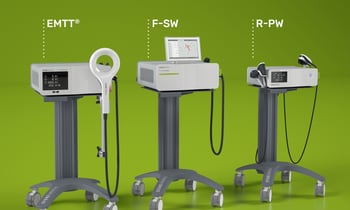
Shockwave fits naturally into multimodal care, with Radial Pressure Wave (Extracorporeal Pulse Activation Technology, EPAT®) addressing broader, superficial treatment areas and Focused Shockwave (Extracorporeal Shockwave Therapy, ESWT) targeting precise areas at greater depths. Both can be complemented by EMTT® (Extracorporeal Magnetotransduction Therapy), which uses electromagnetic rather than acoustic energy.
This blog explores the role of multimodal care in treating MSK conditions, examines research on combining Shockwave and EMTT, and discusses how training, clinical integration, and ongoing support help practices make the most of these technologies.
The Importance of Multimodal Treatments for MSK Practices
 Musculoskeletal conditions often come with interconnected rehabilitation challenges: pain limits movement, weakness affects function, and everyday activities can continue to strain recovering tissues, slowing the healing process. Multimodal care allows medical professionals to address several of these factors within a coordinated treatment plan.
This approach is well established in rehabilitation. A 2026 analysis mapping 409 publications highlighted the central role of exercise combined with education, manual treatment, and behavioral strategies, with different combinations emphasized across conditions.
Depending on the patient’s needs, these approaches may include:
- Therapeutic exercise: Progressive strengthening and mobility work to rebuild function and tolerance for activity.
- Manual treatment: Hands-on techniques to help manage symptoms and support movement alongside exercise.
- Patient education and activity modification: Guidance on managing physical demands, progressing activity, and following a home rehabilitation plan.
- Cognitive behavioral strategies: Support for managing persistent pain, addressing fear of movement, and building confidence in returning to activity.
For practices, this means tailoring care to both the underlying condition and the factors affecting each patient’s recovery, then adjusting the plan as they progress.
Shockwave brings an additional option to this continuum, supported by decades of research across musculoskeletal applications. Combining it with EMTT extends that multimodal approach. The research below examines what this combination can contribute to patient outcomes.
Evidence for Multimodal Treatment Incorporating Shockwave and EMTT
Research on combining Shockwave and EMTT offers encouraging findings for pain relief, functional improvement, and recovery. The following studies and case reports examine the technologies together, providing examples of their potential role in musculoskeletal care.
 Greater pain relief and shoulder function at six months: A randomized controlled trial involving 86 patients with rotator cuff tendinopathy compared Shockwave plus EMTT with Shockwave plus sham EMTT. Both groups improved, but patients receiving the active combination experienced significantly greater pain reduction and improvement in shoulder function at 24 weeks. These findings support the potential value of adding EMTT to Shockwave for patients with persistent rotator cuff symptoms.
Study: Electromagnetic transduction therapy and shockwave therapy in 86 patients with rotator cuff tendinopathy: A prospective randomized controlled trial. Electromagnetic Biology and Medicine, 2018.
- Return to activity approximately nine weeks sooner after surgery: A 2025 pilot study compared 10 patients receiving Focused Shockwave and EMTT following foot and ankle surgery with 10 matched controls. Patients receiving the combination returned to activity in an average of 13.2 weeks, compared with 22.4 weeks for controls, and reported significantly lower pain during postoperative weight-bearing. Radiographic evidence of healing was also more common at four weeks.
Study: Focused shock wave therapy (ESWT) and electromagnetic transduction therapy (EMTT) may improve post-operative bone healing in selective foot and ankle surgeries: a case-control pilot study. Journal of Orthopaedic Surgery and Research, 2025.
- Complete bone healing following postoperative nonunion: A 2026 case report described a 51-year-old man with persistent pain and limited mobility from nonunion after high tibial osteotomy. Following five sessions of combined Shockwave and EMTT, imaging four weeks later confirmed complete bone healing. The patient recovered without complications or revision surgery, offering an encouraging example of the combination’s potential in a challenging postoperative case.
Study: Successful treatment of nonunion after high tibial osteotomy using combined Extracorporeal Magnetotransduction Therapy (EMTT) and Extracorporeal Shock Wave Therapy (ESWT): a case report. Electromagnetic Biology and Medicine, 2026.
- Healing in a persistent wrist nonunion after two surgeries: A case report described a 31-year-old man with ongoing wrist pain and scaphoid nonunion despite two previous operations. He received three sessions of combined Focused Shockwave and EMTT, alongside cast immobilization. Imaging five weeks after the final session showed bone consolidation, highlighting a potential application for the combined approach in complex bone-healing cases.
Study: Novel extracorporeal magnetotransduction therapy with Magnetolith and high-energy focused electromagnetic extracorporeal shockwave therapy as bone stimulation therapy for scaphoid nonunion: A case report. Medicine: Case Reports and Study Protocols, 2020.
Getting the Most Out of Shockwave for MSK Treatments
Getting the most out of Shockwave and EMTT requires not just acquiring the right devices, but developing the skills to apply them effectively within your existing approach to care. Hands-on training and ongoing education help medical professionals match treatment parameters to tissue and pathology, refine technique, and recognize when a combined approach may benefit a patient.
Integrating these technologies into your practice also requires practical decisions: who will perform treatments, how appointments will fit the schedule, and where Shockwave and EMTT belong alongside rehabilitation and other interventions. Staff engagement and clear patient communication help make them a consistent part of your continuum of care, enabling patients to understand why treatment is recommended and what to expect.
Explore Shockwave and EMTT for Your Practice
A multimodal approach gives medical professionals more ways to help patients reduce pain, restore function, and return to the activities they love. CuraMedix supports that goal with the full suite of STORZ Medical Radial Pressure Wave, Focused Shockwave, and EMTT devices, backed by hands-on training, ongoing education, and dedicated service.
Connect with the CuraMedix team to discuss how Shockwave and EMTT can complement your existing treatments and expand your practice’s capabilities.
Frequently Asked Questions
What Is Multimodal Treatment for Musculoskeletal Pain?
Multimodal treatment combines complementary approaches to address pain, tissue recovery, and physical function. Depending on the condition, a plan may include exercise, manual treatment, activity modification, patient education, and technologies such as Shockwave and EMTT. Each component serves a specific purpose within the patient’s overall recovery plan.
Why Combine Shockwave and EMTT?
Shockwave and EMTT use different forms of energy, giving medical professionals complementary tools for musculoskeletal care. Shockwave delivers acoustic energy, while EMTT uses electromagnetic energy. Published research has explored their combined use in rotator cuff tendinopathy, postoperative recovery, and challenging bone-healing cases, with encouraging findings that vary by condition and study design.
Can Shockwave and EMTT Be Used Alongside Physical Rehabilitation?
Yes. Shockwave and EMTT can be incorporated into a treatment plan that includes progressive strengthening, mobility work, and activity modification. Rehabilitation helps patients rebuild the capacity needed for daily activities, while the medical professional coordinates treatment timing and progression around the patient’s condition and response.
Is EMTT a Form of Shockwave?
No. The two forms of Shockwave discussed here are Radial Pressure Wave, also called EPAT, and Focused Shockwave, also called ESWT. EMTT is a related technology that uses electromagnetic energy rather than acoustic energy. These differences allow medical professionals to consider distinct applications for each within a multimodal plan.
What Is the Best Multimodal Treatment Plan for MSK Conditions?
The best multimodal treatment plan is tailored to the diagnosis, affected tissues, functional limitations, previous treatment response, and patient goals. It commonly combines appropriate exercise and patient education with additional treatments selected to support recovery. Shockwave and EMTT may be valuable components when supported by the clinical assessment and condition-specific evidence. Regular reassessment helps medical professionals adjust the combination as the patient progresses.

