


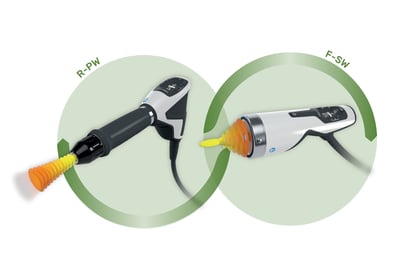
 Today, Shockwave has matured into a widely adopted, evidence-based approach for stimulating tissue repair and regeneration. Medical professionals around the world rely on non-invasive, energy-based treatments like EPAT® (Extracorporeal Pulse Activation Technology) and ESWT (Extracorporeal Shockwave Therapy) to address a broad range of musculoskeletal and soft tissue conditions.
Since its early use in the 1980s, the body of clinical research surrounding Shockwave has expanded significantly, both in volume and in scope. What began as a focused area of study within orthopedics now spans multiple clinical disciplines, supported by a steadily growing foundation of peer-reviewed studies, randomized controlled trials, and meta-analyses.
In this article, we take a closer look at how Shockwave research has developed over the last 30 years, and what that means for medical professionals. Drawing on interviews with expert medical practitioners who use Shockwave, we explore the trajectory of the evidence and what it means for practices integrating Shockwave treatments into patient care.
For another expert perspective on how the evidence on Shockwave research has grown over time, check out our discussion with Helen How, DO, who recently conducted a comprehensive Shockwave literature review.
How Shockwave Research Has Matured
 The story of Shockwave’s evolution is truly remarkable. Its first use was Lithotripsy in the 1980s (breaking kidney stones using acoustic force).
Prof. Dr. Karsten Knobloch, MD, observed just how deep these roots go: “ESWT has been extensively studied since 1980, with more than 800 papers in 2025 for ESWT alone. This demonstrates the still high tide of ESWT research in recent years!
Few medical professionals in the 1980s might have guessed that this
technology would mature into an evidence-based approach for regenerating tissue, but early users began to notice that bone around the treatment field was growing, not breaking.
That observation changed everything for Shockwave research, and further exploration in the 1990’s focused on challenging orthopaedic issues, conditions like plantar fasciitis, calcific tendinitis, and tennis elbow, where conventional medicine had essentially given up. At this stage, the underlying mechanisms were still not understood, but the benefits for patients were too significant to ignore (Shockwave has an 80+% patient satisfaction rate). understood.”
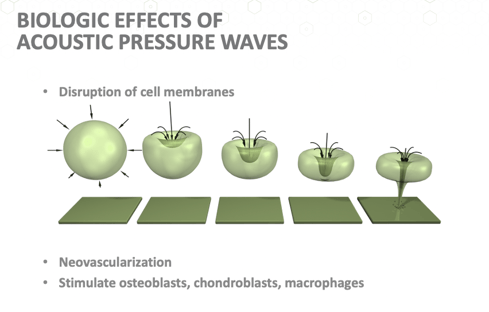
Cells responding to acoustic waves.
How Shockwave Research Explained the Benefits to Patients
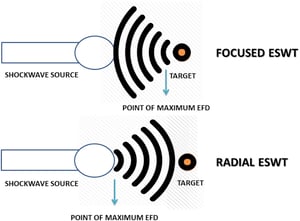 By the 2000s, an even broader body of research began to emerge, and today, researchers have a far more granular understanding of what makes Shockwave so effective for patients. A paper published in the Journal of Clinical Orthopedics and Trauma summarizes this research as follows:
"Shockwaves can generate interstitial and extracellular responses, producing many beneficial effects such as: pain relief, vascularization, protein biosynthesis, cell proliferation, neuro and chondroprotection, and destruction of calcium deposits in musculoskeletal structures. The combination of these effects can lead to tissue regeneration and significant alleviation of pain, improving functional outcomes in injured tissue.”
Shockwave Research Grows Across Multiple
Treatment Areas
 In addition to a deeper understanding of its underlying mechanisms, Shockwave research has also dramatically expanded its breadth beyond early evidence.
New areas of research include:
- Cardiovascular: Shockwave driving angiogenesis in ischaemic myocardium.
- Neurological: Transcranial Pulse Stimulation for Alzheimer’s disease, depression, Parkinson’s.
- Wound Healing: including chronic diabetic wounds that have failed every conventional approach.
- Spinal cord injury models.
- Oncology-related tissue damage.
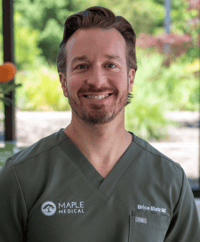 Reviewing the incredible breadth of positive outcomes now supported in the research, Dr. Brice Blatz, MD, and President of ASMST (The American Society for Medical Shockwave Treatment) argues that "It is crucial now for medical professionals to recognize the depth and quality of this research on Shockwave. The sheer volume of positive outcomes demands that we move past skepticism and integrate this proven modality into standard care protocols.”
Learn More About Implementing Shockwave
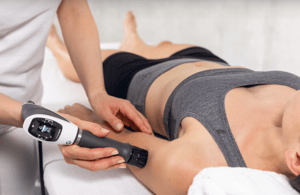 Three decades of research have made one thing clear: Shockwave is a well-established, evidence-based approach to supporting tissue repair and regeneration. But translating that research into consistent clinical outcomes depends on more than just acquiring the right technology.
Not all Shockwave solutions are created equal, and it’s important to choose the best Shockwave therapy device for your practice. That means not only finding the right device, but a business partner who can back it with the right training, education, and ongoing support.
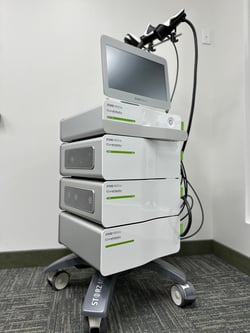
CuraMedix supports medical professionals by offering not only the complete suite of STORZ Medical Shockwave and EMTT devices but also a commitment to the best practices that drive successful integration with patient care.
Connect with the CuraMedix team to learn more about integrating Shockwave into your practice.
Frequently Asked Questions About Shockwave
How has Shockwave therapy research evolved over the past 30 years?
Shockwave research has progressed from early clinical validation in musculoskeletal conditions to a more sophisticated understanding of its underlying biological mechanisms. Today, the evidence base includes randomized controlled trials, meta-analyses, and expanding research across multiple clinical specialties.
Why is long-term research important for Shockwave therapy?
A multi-decade body of research provides clinicians with confidence that treatment outcomes are consistent, reproducible, and grounded in both clinical results and biological understanding. It also helps establish appropriate treatment protocols and patient expectations.
What does “evidence-based” mean in the context of Shockwave therapy?
Evidence-based Shockwave therapy refers to the use of Shockwave treatments as supported by peer-reviewed clinical studies, including trials that evaluate safety, efficacy, and long-term outcomes across a range of conditions.
What role does Shockwave therapy play in modern patient care?
Shockwave therapy is often used as a non-invasive treatment option for musculoskeletal conditions, particularly when conservative approaches have not produced sufficient results. It can support tissue repair while helping patients avoid more invasive interventions.
How does Shockwave therapy support the body’s natural healing processes?
Shockwave delivers controlled mechanical energy into tissue, which stimulates biological responses associated with repair and regeneration. These responses can include increased circulation, cellular activity, and tissue remodeling over time.
Can Shockwave therapy be used as part of a broader treatment approach?
Yes, Shockwave therapy is frequently integrated with other non-invasive and regenerative treatments to support a comprehensive approach to patient care. Combining therapies can help address multiple aspects of tissue healing and recovery.

