EPAT/ESWT for Bilateral Sever’s Disease in a 13-Year-Old Competitive Gymnast
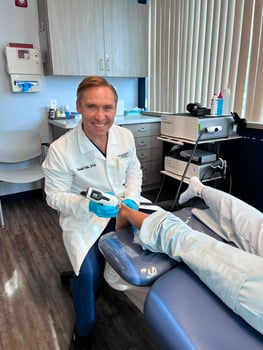
Dr. Donald E. Pelto, DPM, of Central Massachusetts Podiatry recently treated a 13-year-old competitive gymnast experiencing persistent bilateral heel pain associated with Sever’s disease.
The young athlete, Tim M., was competing at a high level and training much of the year. Repeated heavy landings placed substantial demands on his heels, and persistent symptoms were beginning to interfere with his ability to compete.
By the time Tim reached Dr. Pelto, his family had already pursued a wide range of conservative approaches. Physical therapy, taping, icing, anti-inflammatory medications, orthotics, heel cushions, and topical products had failed to provide sufficient improvement.
For Tim and his parents, the goal was straightforward but challenging: find a way to improve his heel symptoms without requiring him to abandon the sport and training schedule that were central to his competitive development.
The Challenge: Persistent Heel Pain in a Growing Athlete
Sever’s disease is a condition Dr. Pelto frequently encounters in young athletes, particularly around ages 12 to 14. In his practice, symptoms commonly appear among athletes exposed to repetitive heel loading, including those participating in soccer and jumping-intensive sports.
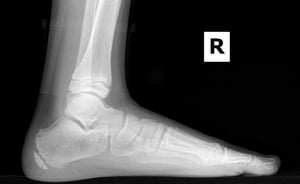
Pediatric heel pain may be mistaken for plantar fasciitis or Achilles tendinitis because those conditions are more familiar. In a growing athlete, however, examination and imaging can point toward a different source.
As young athletes grow, tension from the surrounding musculature and tendon structures can place traction on the growth plate at the back of the heel. Repetitive loading can make recovery particularly challenging for athletes who specialize in a single sport year-round and receive little opportunity for extended rest.
 That dynamic was especially important for Tim. Gymnastics did not allow him to simply rely on supportive footwear during competition, and repeated dismounts required him to land heavily on his heels. His symptoms were severe enough that Dr. Pelto was concerned that altered landing mechanics or limping could eventually lead to compensation elsewhere in the kinetic chain.
The Solution: Bilateral EPAT/ESWT With Tolerance-Based Dosing
After reviewing Tim’s previous treatment history and performing a physical examination, Dr. Pelto elected to use a combined Shockwave approach incorporating Extracorporeal Pulse Activation Technology (EPAT®), or Radial Pressure Wave, and Extracorporeal Shockwave Therapy (ESWT), or Focused Shockwave.
Because Tim’s symptoms were bilateral, Dr. Pelto treated both heels during the same sessions rather than completing a separate treatment series for each side. The initial protocol consisted of six treatments performed one week apart. Tim continued training throughout the treatment period, using heel cushions taped to his feet when possible to provide additional support.
Radial Pressure Wave: Treating the Broader Posterior Heel Region
Dr. Pelto began each session with Radial Pressure Wave. Dr. Pelto treated a broad region across the posterior heel and surrounding Achilles and gastrocnemius-soleus region.
- During the first treatment, Dr. Pelto began with the C15 applicator tip, starting at approximately 15 Hz for the first 500 pulses before reducing the frequency to approximately 12 Hz for the remainder of the treatment. As Tim demonstrated tolerance, Dr. Pelto transitioned to the DI15 tip.
- For subsequent treatments, Tim was generally able to tolerate settings of approximately 2.5 to 3 with the DI15 tip at around 12 Hz. Dr. Pelto used 2,000 pulses during the Radial Pressure Wave portion of the treatment and treated both heels.
Focused Shockwave: Targeting the Most Symptomatic Areas
After Radial Pressure Wave treatment, Dr. Pelto transitioned to Focused Shockwave
- He began at a lower setting of approximately 0.2, gradually increasing according to Tim’s tolerance.
- Tim was generally able to tolerate approximately 0.3 to 0.35, with 2,000 pulses used during the Focused Shockwave portion of the bilateral treatment.
Focused Shockwave was concentrated on Tim’s most symptomatic areas, primarily along the posterior-lateral and posterior-medial heel.
Adjusting Treatment for a Pediatric Patient
Patient tolerance played an especially important role in Dr. Pelto’s approach with this pediatric patient.
He uses a simple green-yellow-red system to guide treatment intensity. Green indicates that treatment is relatively comfortable, yellow represents the therapeutic intensity he is seeking, and red indicates that the setting has become too uncomfortable. When a patient reports entering the red zone, Dr. Pelto reduces the intensity accordingly.
Dr. Pelto said his approach has evolved toward using lower initial intensities with younger athletes and increasing the treatment dose gradually as they become accustomed to the sensation.
“I tend to go lighter-handed, and I don’t care if I’m a little bit light in the beginning. As the patient gets accustomed to it, I’ll be able to get up to the therapeutic dose.”
Dr. Pelto’s protocol also includes morning stretching and foam rolling focused on the posterior gastrocnemius-soleus region. At visits to the office where it was available, Dr. Pelto also used low-level laser treatment as an adjunct.
Follow-Up: Targeted Touch-Up Treatments
Dr. Pelto generally expects patients receiving this protocol to begin noticing improvement around weeks four to five. Tim followed that pattern and was beginning to feel better as the initial six-session series progressed.
At his follow-up six weeks after the initial series, some heel tenderness remained, so Dr. Pelto performed a single additional “touch-up” treatment. Tim returned again 12 weeks later with a small amount of residual tenderness, prompting a second single-session touch-up.
After that treatment, Dr. Pelto reported that Tim was doing well and no longer required further intervention for the condition.
The Result: From Persistent Heel Pain to National Recognition
 Importantly for Tim, treatment did not require abandoning gymnastics. He continued training throughout the protocol and remained engaged in the sport as his symptoms progressively improved.
Following the initial treatment series and two subsequent visits, Dr. Pelto reported that Tim was doing well, had continued competing, and ultimately won the nationals. According to Dr. Pelto, Tim’s family felt that addressing his heel symptoms had been essential to allowing him to compete successfully at that level.
The case also illustrates an important consideration for medical professionals treating young competitive athletes: rest may be difficult to achieve when sport specialization and year-round schedules leave little opportunity for recovery. For Dr. Pelto, the objective was therefore not simply to address Tim’s current symptoms, but to find an approach that could promote recovery within the demands of ongoing training.
In this case, a tolerance-based combination of Radial Pressure Wave and Focused Shockwave allowed him to do exactly that.
Important to Note: The treatments and use of EPAT®, ESWT, and EMTT® described in this article reflect the personal clinical experience of the practitioner and are not intended as claims of efficacy.