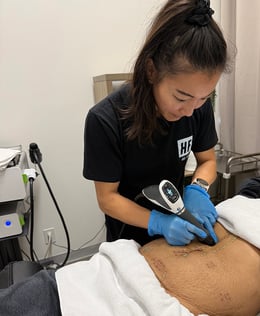
From Debilitating Pain to Restored Mobility: A Multimodal Case Study
Dr. Cheri Chan, PT, DPT, of Healthfit Physical Therapy & Chiropractic in Pasadena, California, recently treated a 66-year-old female presenting with significant functional limitations and autonomic suppression following major abdominal surgery (open subtotal distal pancreatectomy with splenectomy). The patient arrived at Dr. Chan’s clinic feeling deeply discouraged. Despite having undergone a successful surgery, her recovery had plateaued, leaving her unable to enjoy the retirement she had envisioned.
Patient Presentation
Demographics: 66-year-old retired female.
Surgical History: Status post-partial pancreatectomy and splenectomy.
• Following her surgery, the patient had attempted to recover through rest alone, as directed by her surgeon. However, she found that rest was insufficient to address the mounting physical and emotional toll of her symptoms.
Primary Challenges:
• Chronic, debilitating abdominal pain.
• Loss of appetite and early satiety.
• She reported that even attempting to eat was profoundly uncomfortable, causing her to feel full almost immediately.
• Severe restriction in spinal flexion and extension.
Clinical Observations:
• Postural: Flexed-dominant gait and stance (protective guarding).
• Integumentary: Active surgical scars (proximal abdominal) and an old C-section scar with visible keloid formation.
• Mobility: Significant kinesiophobia related to spinal extension.
This physical restriction had stripped her of her independence, making it impossible to perform household chores, cook, or engage in her favorite hobby of shopping.
Through an 8-week protocol utilizing Extracorporeal Magnetotransduction Therapy (EMTT) in combination with Extracorporeal Pulse Activation Technology (EPAT), and Extracorporeal Shockwave Technology (ESWT), Dr. Chan’s patient achieved complete restoration of appetite, normalized spinal kinematics, and a significant reduction in myofascial guarding.
Clinical Reasoning and Intervention
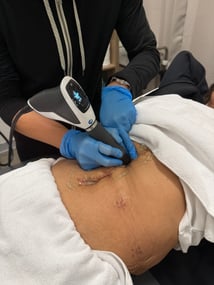 Dr. Chan’s treatment strategy focused on mechanotransduction: using physical forces to trigger a biological response. The goal was to remodel her dense fibrotic scar tissue, reduce her visceral-somatic guarding, and downregulate her sympathetic nervous system to restore digestive function.
While Dr. Chan’s standard approach for surgical scars involves manual mobilization and gradual movement reintroduction, she recognized that this specific case required more intense methods of intervention. She felt that while manual therapy could help, the use of Shockwave and EMTT was essential to accelerate a recovery that would have otherwise been much slower.
The Multimodal Protocol (1x/week for 8 Weeks)
The patient received a combination of Magnetotransduction (EMTT), Radial Pressure Wave (EPAT), and Focused Shockwave (ESWT) over the course of 8 weeks.
Phase 1: Tissue Priming and Desensitization (Weeks 1-3)
The focus for the first few weeks was on superficial scar mobility, as well as reducing the tension of the patient’s abdominal wall. Dr. Chan used all three modalities to reach this goal:
-
Extracorporeal Magnetotransduction Therapy (EMTT):
8 Hz, Level 8, 8000 pulses
Targeted at the proximal scar to improve cellular metabolism.
- Radial Pressure Wave (EPAT):
Atlas tip used for cross-friction of incision sites.
Parameters: 18–20 Hz, 0.5–1.3 bar, 6000 pulses.
Adjunct: Silicone soft cupping at keloid sites to introduce negative pressure and shear force.
-
Focused Shockwave (ESWT):
S2 standoff for targeted energy at incision depth.
Parameters: 0.01 - 0.05 mJ/mm2, 2000 pulses.
Patient Progress Note:
Following Session 1, the patient reported an immediate decrease in restriction and was able to consume a full meal comfortably for the first time in months. This early success provided a significant emotional lift, replacing her earlier discouragement with a sense of hope.
Phase 2: Structural Remodeling (Weeks 3-5)
Increased energy density was introduced as the patient’s pain tolerance improved and her tissues became more compliant.
- EPAT: F15 transmitter (15–18 Hz, 0.8–1.5 bar) focused on proximal-to-distal scar gradient.
- ESWT: Focused on the old C-section scar to address compensatory tethering 0.03 - 0.07 mJ/mm2
As the patient progressed, she began to slowly regain her energy and even returned to her daily activities, such as cooking and staying on top of chores at home.
Phase 3: Consolidation and High-Energy Loading (Weeks 6-8)
In this phase, Dr. Chan focused on the remodeling of deep adhesions.
- EPAT: F15 transmitter (15–18 Hz, 1.0–1.5 bar) along mid-scar and C-section sites.
- ESWT: High-intensity focused treatment (0.1 - 0.12 mJ/mm2) at the proximal scar to ensure long-term elasticity.
A Breakdown of Treatment Parameters
To support the clinical case study, the following charts visualize the progression of treatment parameters. The strategy moved from high-frequency/low-pressure (desensitization) toward higher energy densities and moderate pressures (structural remodeling).
Radial Pressure Wave (EPAT) Application Progression
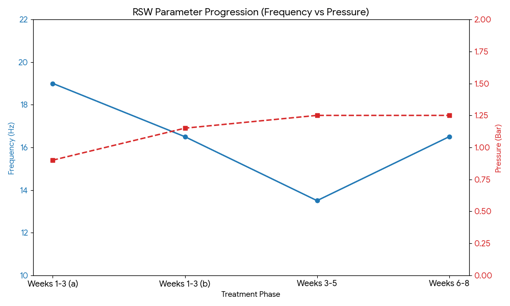
This chart illustrates the relationship between Frequency (Hz) and Pressure (Bar).
- Early Phase: Higher frequencies (18-20 Hz) were used to downregulate pain and address superficial tissue.
- Mid-to-Late Phase: Frequency was lowered to allow for deeper mechanical penetration as the pressure was titrated upward to 1.5 bar.
Clinical Interpretation of the Curve
The "crossover" seen in the EPAT chart, where frequency drops as pressure rises, is an example of mechanotransduction loading strategy. By reducing the frequency (Hz), Dr. Chan allowed the tissue more time to recover between pulses, which facilitated a higher tolerance for the increased pressure (Bar) required to break down mature collagen bonds in the surgical scars.
Focused Shockwave (ESWT) Energy Density
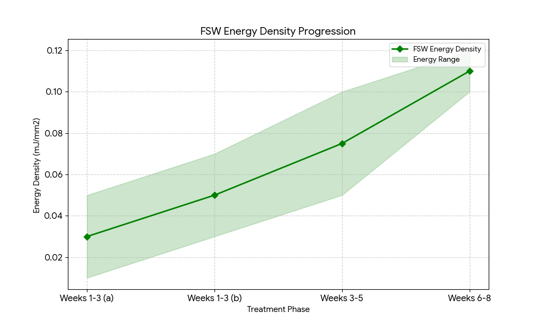
This chart shows the linear increase in Energy Density (mJ/mm2) over the 8-week period.
- Weeks 1-3: 0.01 - 0.07 mJ/mm2 (Low energy for initial cellular signaling).
- Weeks 6-8: 0.10 - 0.12 mJ/mm2 (High energy for localized remodeling of dense fibrotic/keloid tissue).
Treatment Parameter Summary Table
|
Phase
|
EPAT Frequency (Hz)
|
EPAT Pressure (Bar)
|
ESWT Energy Density (mJ/mm2)
|
Primary Clinical Objective
|
|
Weeks 1-3 (Initial)
|
18-20
|
0.5 - 1.3
|
0.01 - 0.05
|
Pain modulation & scar desensitization
|
|
Weeks 1-3 (Subseq.)
|
15-18
|
0.8 - 1.5
|
0.03 - 0.07
|
Increasing mechanical load on scars
|
|
Weeks 3-5
|
12-15
|
1.0 - 1.5
|
0.05 - 0.10
|
Deep tissue mobilization & spinal extension
|
|
Weeks 6-8
|
15-18
|
1.0 - 1.5
|
0.10 - 0.12
|
Final remodeling of proximal adhesions
|
Clinical Outcomes:
|
Metric
|
Pre-Treatment
|
Post-Treatment
|
|
Pain & Restriction
|
High/Constant
|
Significantly Reduced/Intermittent
|
|
Nutritional Intake
|
Low Appetite
|
Normalized/Full Meals
|
|
Postural Alignment
|
Chronic Trunk Flexion
|
Upright/Neutral Spine
|
|
Gait Speed
|
Slow/Guarded
|
Increased/Fluid
|
|
Spinal Range
|
Limited Flexion/Extension
|
Restored Functional Mobility
|
|
Daily Life
|
Unable to cook, clean, or shop
|
Full return to chores and hobbies
|
Discussion
This case demonstrates that post-surgical abdominal pain is often not only visceral, but also a.jpeg?width=214&height=161&name=IMG_2156%20(1).jpeg) complex interplay of myofascial tethering and autonomic suppression. It also highlights the psychological impact of chronic post-operative pain, and by utilizing EMTT to prime the tissue and EPAT/ESWT to mechanically disrupt fibrotic adhesions, Dr. Chan was able to successfully remove the physical "brake" on the patient's spine.
complex interplay of myofascial tethering and autonomic suppression. It also highlights the psychological impact of chronic post-operative pain, and by utilizing EMTT to prime the tissue and EPAT/ESWT to mechanically disrupt fibrotic adhesions, Dr. Chan was able to successfully remove the physical "brake" on the patient's spine.
The restoration of appetite is particularly noteworthy, likely resulting from the reduction of intra-abdominal pressure and the soothing of the celiac plexus through improved fascial gliding. The patient’s transition from a state of "discouraged rest" to a life full of movement serves as a powerful testament to the efficacy of this multimodal approach.
By the end of her 8-week protocol, the patient had not only regained her physical health but also her vitality. She was back to running errands and walking with ease, activities she had previously feared were lost to her forever.
Ready to join Dr. Chan and offer next-level care for your own patients? Contact us today to connect with one of our experts and revolutionize your practice.
Important to Note: The treatments and use of EPAT®, ESWT, and EMTT® described in this article reflect the personal clinical experience of the practitioner and are not intended as claims of efficacy.